
How to Read Basic Drum Notation
Master the drum clef, identify bass, snare, and cymbal symbols on the 5-line staff, and play your first written rock beat accurately from sheet music.
Find the percussion clef, read the staff from bottom to top as kick, snare, hi-hat, and cymbals, then count note values in 4/4.
Watch: How to Read Basic Drum Notation
Read the note values, the hi-hat and snare positions, and count the groove out loud before you play it. · 3:38 minute walkthrough. The full written steps are below.
Read the vertical drum stack
Drum notation is read like a map: vertical position identifies the drum or cymbal, while note shape and beams identify timing.
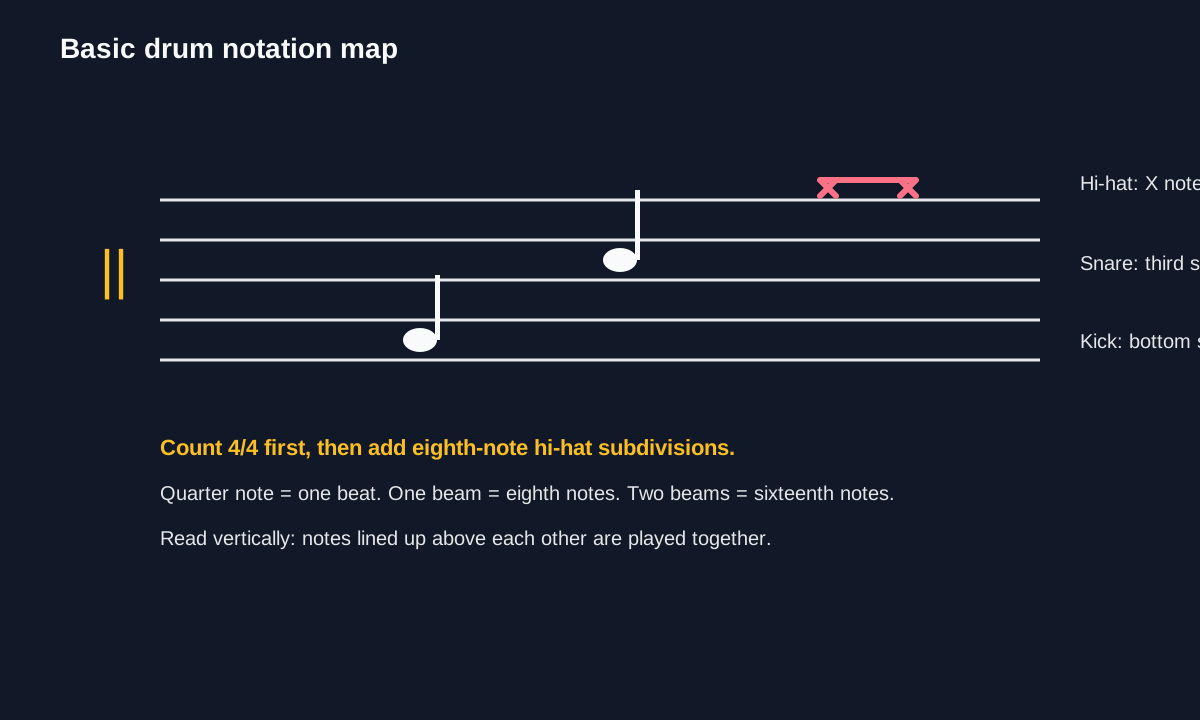
Note values
| Symbol | Beats in 4/4 | Count |
|---|---|---|
| Quarter note | 1 | 1, 2, 3, 4 |
| Two eighth notes | 1 total | 1-and |
| Half note | 2 | 1-2 or 3-4 |
| Whole note | 4 | 1-2-3-4 |
60 BPM practice loop
- Count out loud: 1-and, 2-and, 3-and, 4-and.
- Play hi-hat or tap every eighth note.
- Add kick on 1 and 3.
- Add snare on 2 and 4.
- Loop eight measures without stopping.
Use a metronome and stop if your wrist or forearm tightens.
Learn the surrounding music-reading skills
- Read Bass Clef NotesBuild faster note recognition.
- Read Treble Clef NotesLearn the companion clef.
- Understand Rhythm and Time SignaturesStrengthen note-value counting.
- Practice Drums with a MetronomeTurn the written pattern into steady timing.
- Play a Basic Rock Drum BeatApply the notation to the kit.
Visual step map
See the full sequence before you start, then check off each step as you go.
0 of 6 steps checked
Materials and cost planner
Select the items you plan to buy, adjust any estimated price, and calculate the selected total.
Editable rough U.S. retail estimates. Estimated all listed: $72.00. Prices are planning estimates, not quotes — tax, store, brand, size and quantity will change them.
Time and finish planner
Estimate active working time from the number of steps in this guide.
Practice time calculator
Turn measures, beats and tempo into a realistic amount of practice time for one pass or a repeated loop.
Stop if you feel pain or tension. Slow repetitions with clean technique are usually more valuable than fast repetitions.
- Read the tools, materials, safety notes, and steps below for free.
- Tap See 20-second demo if you want to understand it first.
- Tap Start Camera Coach when you want hands-free help, or Voice-only if you do not want to use the camera.
- Allow camera and microphone. Point your phone at the work; the coach watches your progress and tells you the next step.
🧰 Required Tools & Equipment
- ✓ Pair of 5A drumsticks
- ✓ Practice pad
- ✓ Metronome app
- ✓ Music stand
📦 Materials & Supplies
- ✓ Printed basic drum sheet music
- ✓ Pencil with eraser
⚠️ Safety Checkpoints & Warnings
- • Maintain a relaxed matched grip with loose wrists to prevent repetitive strain injury.
- • Sit upright on a stable stool with thighs parallel to the floor to prevent spinal fatigue.
- • Keep metronome headphone levels below 70 percent volume to avoid auditory fatigue.
📋 Step-by-Step Guide (6 Steps)
Identify the Drum Clef and Staff Anatomy
Place your sheet music on the stand and locate the two vertical parallel bars at the far left, known as the neutral or percussion clef. Notice the standard five horizontal lines and four spaces, which map out specific drum kit pieces rather than melodic pitches. Use your pencil to trace the lines from bottom to top, numbering them 1 through 5 in the margin for quick visual reference.
- • Drum clef clearly marked at the left edge
- • Staff lines numbered 1 through 5 with pencil
- • Confusing the drum clef with a bass clef or treble clef
- • Reading lines as musical pitches (A-G) instead of specific drum voices
Map Drum Voice Locations on the Staff
Locate the bottom space (first space from the bottom), which represents the bass drum (kick). Find the second space from the top (third space), which marks the snare drum. Observe the top line or the space above the staff with an 'X' notehead, which indicates the closed hi-hat cymbal.
- • Labels 'Kick', 'Snare', and 'Hi-Hat' written next to their corresponding vertical staff locations
- • Swapping snare drum (middle space) with bass drum (bottom space)
- • Assuming cymbal notes use standard round noteheads instead of 'X' markers
Decode Note Durations and Rhythmic Values
Look at the shape of the notes to determine their timing within a 4/4 time signature. A solid black oval with a vertical stem is a quarter note, representing one full beat counted as '1', '2', '3', or '4'. Notes connected at the top by a single horizontal bar (beam) are eighth notes, counted as '1-and, 2-and, 3-and, 4-and'.
- • Individual quarter notes distinguished from beamed eighth notes across the measure
- • Confusing open-head half notes with closed quarter notes
- • Miscounting eighth note beams as sixteenth notes which feature double beams
Count and Tap the Quarter-Note Bass and Snare Foundation
Set your metronome to 60 BPM in 4/4 time. Tap your right foot on beats 1 and 3 (where bass drum notes appear in the bottom space) and strike your practice pad with your left stick on beats 2 and 4 (where snare notes appear in the third space). Count out loud '1, 2, 3, 4' in lockstep with the metronome clicks.
- • Right foot taps in sync on beats 1 and 3
- • Stick strikes pad surface cleanly on beats 2 and 4
- • Rushing ahead of the 60 BPM metronome click
- • Striking snare on beat 1 instead of beat 2
Read and Layer the Eighth-Note Hi-Hat Pattern
Examine the continuous line of 'X' noteheads beamed across the top of the measure. Tap your right drumstick on the edge of the pad or a table edge for eight steady strokes per bar, vocalizing '1-and-2-and-3-and-4-and'. Ensure the downbeats land exactly with the metronome clicks and the 'ands' land evenly in between.
- • Right hand playing 8 evenly spaced strokes per measure across the top voice
- • Swinging the 'and' counts unevenly instead of maintaining straight subdivision
- • Tensing up the forearm during continuous eighth-note motion
Perform the Full Vertical Notation Score
Read the full measure vertically from left to right: on beat 1, strike the hi-hat and kick simultaneously; on beat 'and', strike hi-hat alone; on beat 2, strike hi-hat and snare together. Continue this vertical alignment through beats 3 and 4, keeping your eyes tracking one beat ahead on the printed page.
- • Simultaneous limb strikes occurring precisely on beats 1, 2, 3, and 4
- • Continuous eighth-note hi-hat pulse maintained without pausing
- • Flamming limbs instead of striking kick/snare and hi-hat at the exact same microsecond
- • Stopping between measures rather than looping smoothly at 60 BPM
Don’t have everything?
- No Practice pad? Mousepad, heavy hardcover book, or couch cushion
- No Metronome? Free metronome app on a smartphone
- No Drumsticks? Thick unsharpened pencils or wooden kitchen spoons
Frequently asked questions
What does the bottom space mean in drum notation?
In standard drum notation, the bottom space usually represents the bass drum, also called the kick.
Where is the snare written?
The snare is commonly written in the third space from the bottom of the staff.
What does an X notehead mean?
An X notehead usually indicates a cymbal, such as a closed hi-hat.